






Exposición
-> 1 sep – 30 sep
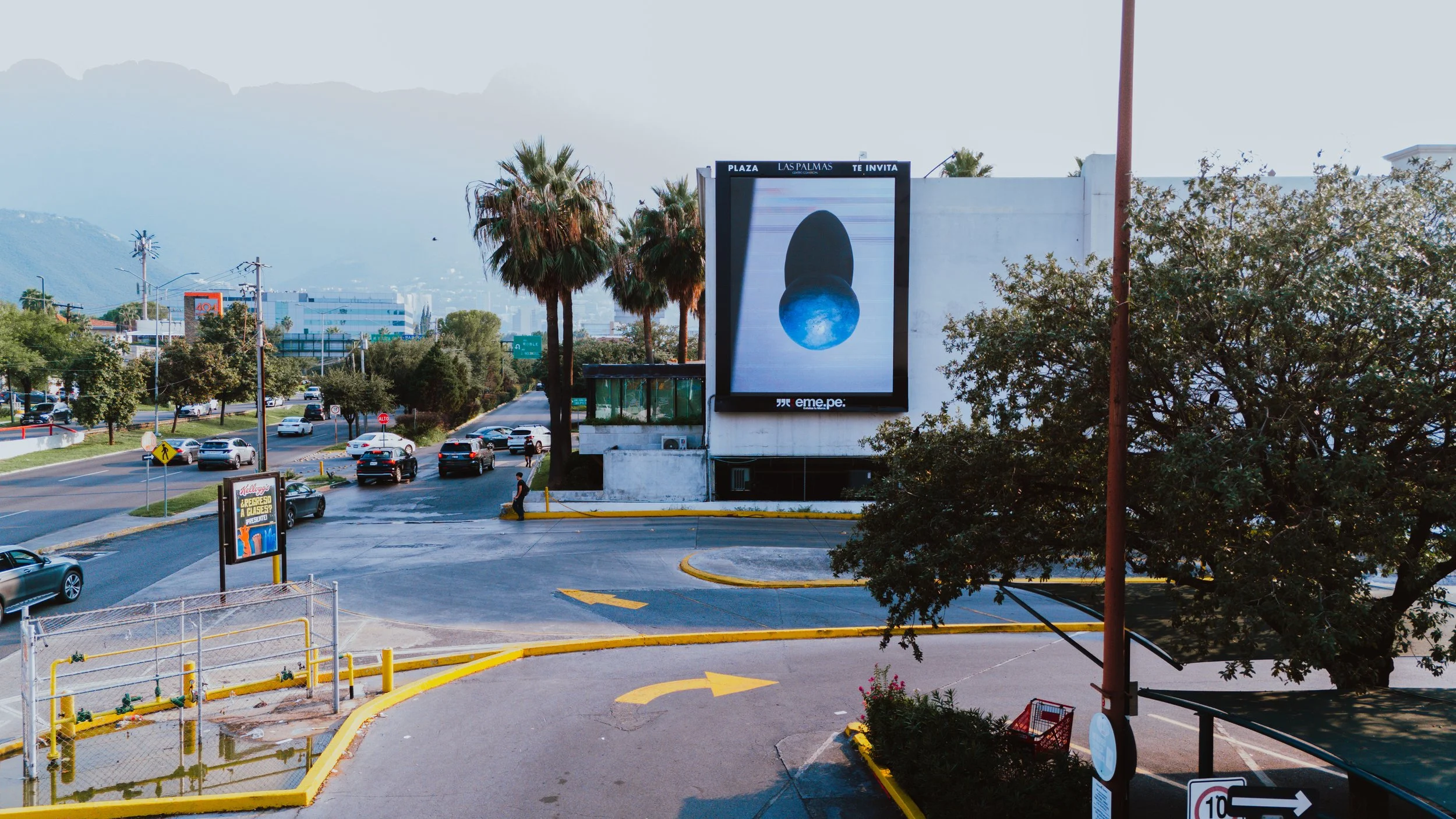
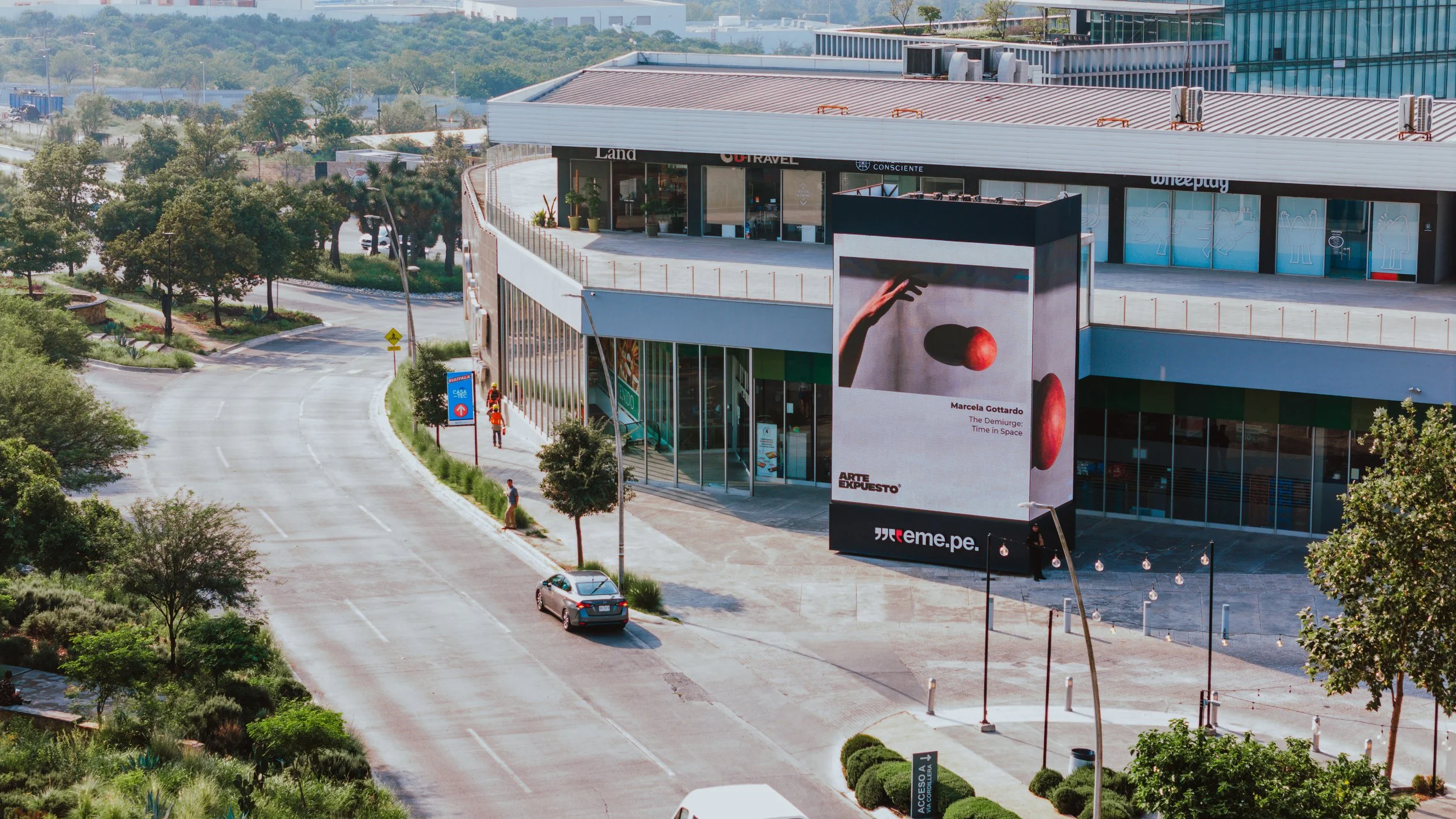
Arte Expuesto presenta The Demiurge: Time in Space, obra de Marcela Gottardo que podrá verse en los panorámicos de la ciudad como parte de la ruta expositiva del mes.
La obra surgió mientras meditaba sobre las diversas maneras en que la mano ha sido representada en la cultura humana a lo largo de la historia, desde las impresiones negativas de manos encontradas en las cuevas paleolíticas hasta los mudras del Buda en India, los gestos de manos y las posturas de los dedos, el fresco de Miguel Ángel Buonarroti "La Creación de Adán" en la Capilla Sixtina, el compás de mano de William Blake, y la mano impresa de Marcel Duchamp.
Una antigua huella de una mano en una cueva apunta a su resistencia a la destrucción del tiempo, pero también nos dice que nosotros somos tiempo.
Podemos pensar en el tiempo como un espacio externo, el tiempo que toma de un punto a otro, o que los fenómenos constituyen el tiempo, y también podemos pensar en el tiempo como una conciencia interna, el horizonte del ser mismo.
En mi exposición anterior para Arte Expuesto, Fragmento-Totalidad, 2023, también utilicé la impresión negativa de mi mano como tema.
Desde mi perspectiva, el tema de la mano en el arte esencialmente señala las diferentes maneras en que los seres humanos han representado históricamente la génesis, lo divino, a través de mitos e historias.
Coloqué mi mano izquierda contra la esquina de mi estudio y tomé una foto. Imprimí la fotografía y la dejé reposar en el suelo de mi habitación durante varios días, observando cómo la luz del sol creaba sombras desde la ventana. Decidí añadir las esferas que había hecho en arcilla sobre la imagen.
Las esferas no estaban destinadas a ser perfectas; son más o menos del tamaño de la mano y conservan el proceso de su creación. Son representaciones de una forma ideal, como postula Platón. Los colores fueron elegidos intencionalmente para representar los cuatro elementos psico-físicos que constituyen nuestra totalidad como seres, según textos místicos y el psicoanálisis contemporáneo: el agua es verde y representa la mente, el fuego es rojo y representa el espíritu, el aire es azul y representa el alma, y la tierra es marrón y representa el cuerpo.
El gesto de la mano representa un acto consciente.
Una vez que la imagen de la mano fue impresa, se volvió objetiva y estableció el escenario para las esferas. La luz natural del sol creó formas de sombras perpendiculares y oblicuas, activando todos los elementos de la obra, apareciendo como formas y desapareciendo como materia, revelando su esencia en forma pura. El formalismo, según lo veo, es la esencia de la forma en la materia, o la calidad estructural fundamental de la materia, que es su representación.
Este aparecer y desaparecer de la forma y la materia es inmediato, no hay un antes y un después, y no puede considerarse como una cosa transformándose en otra, sino como eventos que ocurren.
La obra no es un objeto, no puede levantarse o moverse, depende de las circunstancias naturales de la luz, y es inestable. Solo existe como una tercera y cuarta imagen, un registro de acciones y huellas realizadas en un determinado tiempo y espacio. La imagen vertical se convierte en un objeto horizontal solo para volver a convertirse en una imagen vertical, conteniendo todos los procesos de transición que crean un sentido interior de gravedad o tiempo.
El Demiurgo, una figura tanto filosófica como mitológica, es un ser divino dotado de capacidad generativa, descrito por primera vez por Platón en el Timeo.
Creador y padre del universo, el Demiurgo es, en el mito platónico, una fuerza ordenadora, imitadora y modeladora, que vivifica la materia, dándole forma, orden y, sobre todo, un Anima Mundi.
A nivel filosófico, el Demiurgo corresponde a la necesidad de introducir un principio unitario capaz de justificar y superar el rígido dualismo teorizado por Platón entre el mundo de las ideas y la realidad sensible. Este artesano divino representa, por lo tanto, el mediador entre la dimensión inteligible y la materia, un dualismo que de otro modo sería inseparable. El Demiurgo es, de hecho, la inteligencia que diseña el mundo, observando las ideas como modelo y utilizando la materia (o chora) como herramienta.
Las ideas platónicas son eternas, necesarias y preceden cualquier origen temporal. Son el objeto de la verdadera intelección como "forma pura". Por lo tanto, están exentas de generación y corrupción, a diferencia del mundo sensible que, por el contrario, es generado y corruptible. El mundo sensible, sujeto al devenir y generado, debe necesariamente descender de un principio, ya que no hay generación sin causa. El Demiurgo, estando inextricablemente ligado a la idea de Bien, no puede sino crear el mejor de todos los mundos posibles.
Aunque tiene las ideas hiperanímicas como modelos eternos, el Demiurgo está vinculado a la "minoría ontológica" del mundo sensible. Por lo tanto, el Demiurgo no crea ex nihilo (de la nada), sino que se ve obligado a operar transmitiendo la forma ideal a una materia preexistente.
Esta obra de arte me recuerda que las acciones artísticas son acciones demiúrgicas, divinas o conscientes. En este momento, el alma se da cuenta de que el Kosmos ya es perfecto y, en este límite, se encuentra libre para jugar y es consciente de sí misma.
La conciencia no es sinónimo de racionalidad como podríamos pensar; es todo, porque solo existe el todo, pero las acciones conscientes son sinónimo de ética. Y la ética no es un código de reglas que podamos encontrar en el mundo; es algo mucho más impersonal que eso.
Elegí esta pieza para Arte Expuesto con el fin de crear un espacio de contemplación en la rutina diaria de la ciudad. Nos hemos acostumbrado tanto a las distracciones, al activismo y a la propaganda gubernamental. Alimentados por imágenes exteriores, estamos perdiendo la capacidad de crear imágenes internas, olvidando nuestra esencia.
— Marcela Gottardo
https://www.youtube.com/watch?v=6GibSheW_E4
Arte Expuesto, Monterrey, N.L., Mexico, 2024
The Demiurge: Time in Space
The work emerged while I was meditating about the various ways that the hand has been portrayed in human culture throughout history, from the negative prints of hands found in Palaeolithic caves to the Indian Buddha mudras, hand gestures, and finger postures, Michelangelo Buonarroti's alfresco "Creazione di Adamo" in the Sistine Chapel, the hand compass of William Blake, and Marcel Duchamp's printed hand.
An ancient trace of a hand in a cave points to its resistance to the destruction of time, but it also tells us that we are time.
We can think of time as external space, the time it takes from one point to another, or that phenomena constitute time, and we can also think of time as internal consciousness, the horizon of being itself.
In my previous exhibition for Art Expuesto, Fragment-Whole, 2023 I also utilized the negative print of my hand as subject.
In my perspective, the subject of the hand in art essentially points to the different ways human beings have historically represented Genesis, the divine through myths and stories.
I posed my left hand against the corner of my studio and took a picture. I printed the photograph and allowed it to sit on the floor of my bedroom for many days observing the sun's light creating shadows from the window, I decided to add the spheres I’d made in clay on top of the image.
The spheres were not meant to be perfect; they are more or less the size of the hand and retain the process of making them. They are representations of an ideal form as it posits Plato. The colors were purposefully chosen to represent the four psycho-physical elements that constitute our totality as beings according to mystical texts and contemporary psychoanalysis: water is green represents the mind, fire is red represents the spirit, the air is blue represents the soul, and earth is brown represents the body.
The hand gesture represents a conscious act.
Once the image of the hand was printed it became objective and set the stage for the spheres. The sun's natural light created perpendicular and oblique shadow shapes activating all the elements of the work appearing as forms and disappearing as matter revealing its essence, in pure form. Formalism, as I see it, is the essence of form in matter, or the fundamental structural quality of matter, which is its representation.
This appearing and disappearing of form and matter is immediate, there is no before and after and it can not be considered one thing transforming into another thing but events happening.
The work is not an object, it can’t be lifted or moved around, it depends on the natural circumstances of light, and it is unstable. It only exists as a third and fourth image, a record of actions, and traces, performed at a certain time and space. The vertical image becomes a horizontal object only to become a vertical image again holding all the transition processes creating an interior sense of gravity or time.
This artwork reminds me that artistic actions are demiurgic actions, divine, or conscious actions. In this moment the soul becomes aware that the Kosmos is already perfect and in this confine, it finds itself free to play and is aware of itself.
Consciousness is not synonymous with rationality as we might think, it's everything because there is only everything, but conscious actions are synonymous with ethics. And ethics is not a code of rules that we can find in the world, it is much more impersonal than that.
I chose this piece for Art Expuesto to create a space for contemplation in the everyday life routine of the city. We have become so accustomed to distractions, activism, and government propaganda. Feed by exterior images we are losing the capacity to create internal images, forgetting our essence.
The Demiurge, a philosophical and at the same time mythological figure, is a divine being, endowed with generative capacity, described for the first time by Plato in the Timaeus.
Creator and father of the universe, the Demiurge is in the Platonic myth an ordering, imitating, shaping force, which vivifies matter, giving it a form, an order, and above all an Anima Mundi.
On a philosophical level, the Demiurge corresponds to the need to introduce a unitary principle capable of justifying and overcoming the rigid dualism, theorized by Plato, between the world of ideas and sensible reality.
This divine craftsman therefore represents the mediator between the intelligible dimension and matter, an otherwise inseparable dualism. The demiurge is in fact the intelligence that designs the world, looking at ideas as a model and using matter (or chora) as a tool.
Platonic ideas are eternal, necessary and precede any temporal origin. They are the object of true intellection as "pure form". They are therefore exempt from generation and corruption, unlike the sensible world which is on the contrary generated and corruptible. The sensible world, subject to becoming and generated, must necessarily descend from a principle since there is no generation without a cause. The Demiurge, being inextricably linked to the idea of Good, cannot but create the best of all possible worlds. Although having the hyperuranic ideas as eternal models, the Demiurge is linked to the "ontological minority" of the sensible world. The Demiurge therefore does not create ex nihilo (out of nothing) but is forced to operate by transmitting the ideal form to a pre-existing matter.